The Harebrain

Archive for the ‘Sports’ Category

Dear World Cup: It’s not you. It’s me.

Despite the best efforts of my 13-year-old son, a monthly subscriber to Soccer America and a devoted fan of English League Football, I’m suffering from a serious interest deficit in this year’s World Cup. And the sad truth is, the American in me is winning-out over my own best efforts to maintain the same level of interest I had four years ago.

Forget, for a moment, that the US soccer team’s chances of winning The Cup are about as strong as Dale Junior’s. It’ll take nothing short of a tectonic shift in the sport (most notably the off-sides rule) and/or the American psyche for soccer to generate anywhere near the interest it commands in the rest of the world.

The most obvious problem is, of course, the lack of scoring; an Unforgivable Sin in a culture increasingly insistent on instant gratification. Adding insult to injury, there’s the all-too-frequent occurrence of games ending in draws. As Rick Reilly (one of our least parochial sportswriters, in my experience)  wrote in his June 15 column on espn.com,  “In the NFL in the past 10 years, there have been two ties. In the first 11 games of this World Cup, there have been five ties. I hate ties. Doesn’t anybody want to win in this sport?”

Lack of scoring, however, is only one element of the more serious disconnect between soccer and literally every sport with a popular following in this country: It simply isn’t TV friendly.

For starters, there’s the near-impossible task of Americanizing the broadcast with eye-catching graphics, stats and human interest stories—since the “action” (a term itself with which many Americans would take issue) only stops for serious injuries. For one, it relegates the match commentators’ role in the perceived drama to the level of pinball-game narrators. And, for another, it eliminates the possibility of all-important beer-grabbing and/or bathroom-visiting during commercial breaks—while minimizing opportunities for highlight-show-worthy instant replays.

Soccer is, overwhelmingly, a game of flow—whereas virtually every popular American sport hinges on The Moment: Fourth down. Ball at the one foot line. Penn State down by six points. These are the moments we’ll discuss between plays, during timeouts, at the water cooler, across the dinner table, on the talk shows (hell, everywhere) for decades—and in American sports, virtually every big game produces scores of those Moments. Not so in soccer.

Moreover, because of that Big Moment structure, the crowds in American sports play a central role in the games’ drama. We love hearing the roar before and after every big play—in the same way that we love our sitcoms filmed before live studio audiences: That way, the folks at home always know when to roar, or laugh, as the case may be.

Soccer crowds have never been particularly punctuative. But this year, the human voice of the crowds is utterly de minimis, under the unsurpassingly-irritating drone of the vuvuzelas (3-foot-long plastic trumpets)—which South African fans blow, without so much as an inhale, from well before the national anthems to well after final whistle. Given their average 130-decibel output (10 above the human pain threshold), numerous players have complained they can’t hear themselves thinking—and (again, the TV issue) it’s forced ESPN’s technicians to dramatically alter the sound mix.

Yes, I understand vuvus are an important part of the South African culture—and since they’re the host nation, I should be sensitive enough to accept them. But the American in me cannot listen to those horns blare without asking, “Seriously, what the hell?” I’d honestly rather hear Mississippi State’s clanging cowbells.

And finally, for me the World Cup has suffered greatly in comparison to this year’s unusually compelling NBA Championship Series—Game Five of which, for instance, produced a third quarter so highlight-filled that even my wife was glued to the set. Except, of course, during the commercials—when we enjoyed every available opportunity to recount the Moments, grab more beers, and run to the bathroom. Because after all, that’s what we Americans like to do.

This column (which was written during the World Cup’s first round, or Group Stage) appears in the July print edition of B-Metro Magazine

That’s How We Do Things Here. (why there’s no sports brand like the masters)

Sunday, April 11 marked the final round of the only golf tournament I watch every year. Which got me thinking why I have to watch The Masters—but no other annual tournament.

After all, several U.S. courses are ranked ahead of Augusta in both Golf.com and Golflink.com’s Top 100 lists. At least seven PGA tournaments match or exceed The Masters’ prize money for first place. It’s located in a town that’s never been widely renowned for anything outside of the tournament. And the entrance to Augusta National is about a block from an unsightly stretch of four-lane Generica.

So what is it about the Masters that makes it possibly the most prestigious brand in all of sport? I think it has to do with the reverence Augusta National has shown for the game of golf since its earliest days—and the standards of behavior that go with it.

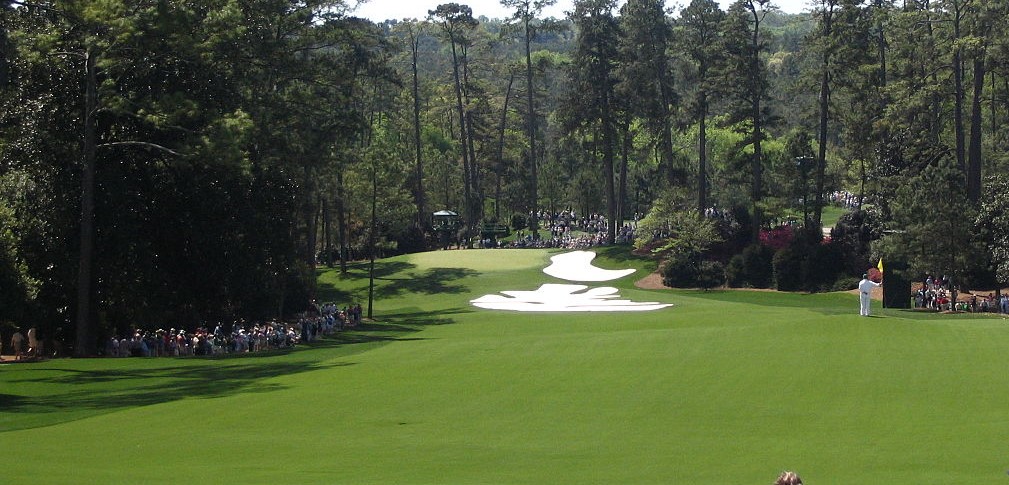
I spent a Friday at the Masters in 2004, and I can honestly say it was the most respectful crowd of people I’ve ever seen. Anywhere. Think about that: The typical Masters attendee is a corporate titan who’s accustomed to hearing his minions drool praise over every thought that proceeds from his often-wide-open mouth. And yet, when any golfer (down to the lowliest teenage amateur) is lining-up a putt, you could close your eyes and swear you were the only person standing beside the green.

That standard of behavior extends to every square inch inside those hallowed grounds—including the concession area (where, by the way, you can still get an egg salad sandwich for $1.50 and a Heineken for $2). Everyone, on both sides of the counter, is polite, patient and genuinely friendly.

My favorite Augusta National policy is stated in bold type on the course maps (which are distributed to patrons free of charge): If you are found with a beeper or cell phone inside the grounds, you will be removed immediately, and your ticket privileges will be revoked for life.

All of which adds up to a magic you cannot find anywhere else in the sports world—including the Royal Ascot Race in Great Britain, where it’s a lot more about “who’s wearing what” than it is about the competition. And which is why I consider a recent phenomenon to be not merely an unspeakable irritant, but an outright threat to The Masters brand itself. That would be the village idiot bellowing, immediately after every golf shot, “GIT IN THE HOLE!!!”

Consciously or not, the buffoon who shouts this at The Masters has somehow convinced himself that doing so actually enhances enjoyment of the tournament for his fellow attendees, the millions watching at home and the golfers. I’d like to meet a single human being who delights in hearing it once. Much less over and over. And over. And over.

If you asked me, the folks at Augusta National should extend their beeper + cell phone policy to those “GIT IN THE HOLE” monkeys. It cheapens the experience—and with it, The Masters brand. Long before anyone at Augusta National gave a single conscious thought about “branding”, they built The Masters magic on an implicit code of comportment.

Which is why Augusta National chairman Billy Payne is probably the only man alive who could read Tiger Woods the riot act for his off-the-course behavior, and get away with it. For all his personal flaws, Tiger understands that there are simply things you don’t do at Augusta National. For me, that would include loudly ordering a ball to git in the hole. And, hopefully for the last time in Tiger’s career, cursing after a bad shot. Seriously, dude: You’re at The Masters. Act like it.

(Originally published online by B-Metro magazine, 4.19.10).

http://bit.ly/the-masters

You are currently browsing the archives for the Sports category.